
Moobile banking's combination of reach and low costs is changing financial services in the developing world. I just hope financial services companies in industrialized countries are paying attention.
Showing posts with label internal. Show all posts
Showing posts with label internal. Show all posts
Monday, August 2, 2010
M-PESA in a nutshell
Concise and nicely produced video primer from the folks over at CGAP:
Moobile banking's combination of reach and low costs is changing financial services in the developing world. I just hope financial services companies in industrialized countries are paying attention.
Moobile banking's combination of reach and low costs is changing financial services in the developing world. I just hope financial services companies in industrialized countries are paying attention.

Friday, July 23, 2010
A tale of two Vehicles: the Jaguar and the Jugaad
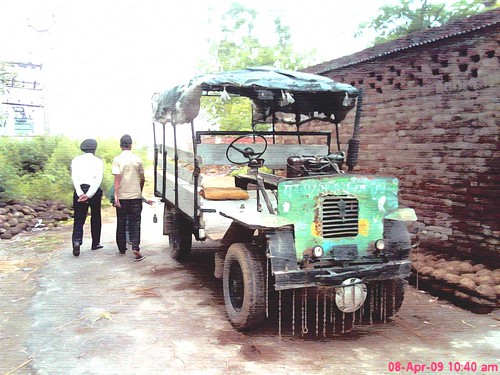
This recent NYTimes op-ed highlights the ingenious Jugaad, a familiar sight in rural India:
(Click to enlarge)

|
|
... Then there is the jugaad (pronounced jew-gaar), which is nothing like a Jaguar.
It is, for one thing, illegal: a truck tossed together, saladlike, in the sheds of northern India, beyond regulators’ view. Parts from old jeeps are cut and welded and combined with wooden planks to form a chassis. An engine commonly used for irrigation pumps is attached.
Actual bells and whistles may be added as adornments, and the wheels are painted by hand.
The truck gives India’s village dwellers a cheap ride: 10 cents for a half-hour journey with a few dozen others. So compelling is their business logic that jugaads have become popular in dowries.
The truck may be obscure, but the culture behind it is now a management fad. Jugaad, not as noun but as verb, is suddenly the talk of consulting firms like McKinsey and companies like Best Buy in the United States.
The slang Hindi verb “jugaad,” as translated for managers, means to make something much like a jugaad. It is to be innovative despite scarcity — a winning formula for hard economic times. Management gurus cite India’s ultra-low-cost creations as inspiration: the $800 electrocardiogram, the $24 water filter, the $2,500 car, the $100 electricity inverter, the $12 solar lamp.
But these represent only a sliver of what jugaad is. It is more than frugal innovation; jugaad is a way of life, here as elsewhere, that has anticipated important movements of the 21st century, from open-source technology to cultural fusion. From years of observation in India, some core tenets emerge, many of use beyond the business world.
FATALISTIC CREATIVITY: India is not an easy place, and to be fatalistically creative is to transcend its hardships. It is to chafe daily against the way things run; to resist the idealistic temptation to change all that; and to strive instead for success and solutions within the constraints.
... MARKET HUMANISM: Jugaad, as a truck and a way of life, involves a capitalism different from the market philosophy that informs the West — and one that prefigured the interesting new directions that capitalism is taking today.
... ANYONE SOURCING: The black-and-yellow Mumbai taxi, an exemplar of jugaad, was crowd-sourced before Wikipedia and open source before Firefox.
... BOTH-AND TRUTHS: A.K. Ramanujan, the late Indian folklorist, once asked whether there was a specially Indian way of thinking. His conclusion was that Westerners were more comfortable with truths applied universally to every case, while Indians resisted the universal, preferring situation-specific solutions. This is philosophical jugaad: an approach to human dilemmas that rejects the either-or.
Thursday, July 15, 2010
mKRISHI: A multi-lingual platform for farmers
This innovative mobile platform lets farmers send data and images to experts and policy makers. In addition to benefiting individual farmers, the crowdsourced and technology-driven data collection has the potential to catch and quickly resolve problems that plague India's large agriculture sector:

mKRISHI is developed by Tata Consultancy Services Ltd (TCS) as an innovative platform to offer personalized and integrated services to farmers. TCS mKRISHI platform combines multiple technologies to bring vital information regarding local weather, fertilizer requirements based on soil conditions, pest control, and current food grain prices in local markets in a rich content format to the farmer’s low-end mobile handsets. It allows farmers to send queries in their local languages, as well as images and voice activated SMS through a mobile phone and provides personal responses with advice or relevant information in these languages.
... Some of the key benefits to farmers are:
* Advice on pesticides/fertilizers, such as how much and when to spray
* Advice on when to harvest in relation to weather to limit crop damage
* Combining yields allows efficient collection of goods
* Market prices made available so they can choose where and when to sell
* Current pricing information for NCDEX, future prices and global rates
* Bankers can use the mKRISHI programme – enabling more rapid loan payments to farmers
* Useful information such as rural Yellow pages, as well as bus times and railway reservations could improve farmers’ activities.

Wednesday, July 14, 2010
Solar powered ATM's
A series of energy efficient ATM's that rely on biometric authentication, Vortex Gramateller ATM's are currently deployed in just under 100 locations in rural India. The ATM's can accept and dispense soiled (or "teller-grade") notes, a must-have feature in rural India:


Friday, June 11, 2010
The behind-the-scenes logistics of M-PESA
The Economist has a brief article on how money flows so smoothly through M-PESA's network of agents. The challenge is to make sure that agents in remote villages are able to regularly swap the cash they receive from customers, for the mobile bank's virtual currency:
... The basic idea of M-PESA is that the 100,000 small retailers in Kenya who already sell mobile-phone airtime, in the form of scratch cards, can also register to be mobile-money agents, taking in and paying out cash. More than 17,600 retailers have signed up as M-PESA agents—far outnumbering Kenya’s 840 bank branches. When a customer is registered with the system, paying in cash involves exchanging physical money for the virtual sort, called “e-float”, which is credited to his mobile-money account. E-float can then be transferred to other users by mobile phone, and exchanged for cash by the recipient, who visits another agent.
It is simple enough for customers. But agents in cities, where most transactions are deposits (see chart), accumulate cash and risk running out of e-float, at which point they cannot take any more deposits. Agents in rural areas, where most transactions are withdrawals, accumulate e-float and risk running out of cash. Keeping the system running requires the agents to manage their liquidity, by regularly swapping cash for e-float, or vice versa.
Exchanging cash for e-float means visiting a bank affiliated with Safaricom, and the whole point of systems like M-PESA is to reach where banks cannot. Accordingly, M-PESA relies on a system of intermediaries (including Mr Eijkman’s firm, PEP Intermedius) between agents and banks. These middlemen have their own distribution networks, and take on much of the work of ferrying cash around the country. But individual agents still handle the “last mile”.
... Rather than many individuals moving money around by carrying it physically, as they had to in the days before M-PESA, the movement of money can then be handled in larger quantities by a smaller number of individuals, which is much more efficient. Safaricom, says Mr Mas, “understood this like no other mobile operator really has”. As well as orchestrating the emergence of the intermediaries, it monitors its agents closely, typically visiting them every two weeks to see how they are handling the growing volume of transactions (on average, each M-PESA agent now handles almost 100 transactions a day).
Monday, June 7, 2010
Dual SIM Mobile Handsets enter the mainstream
In many developing countries, many mobile phone users have long had multiple SIM cards to juggle phone numbers and groups of buddies (work, friends, home). In recent years, local handset makers started introducing models that could accommodate 2 or more SIM cards.
The largest mobile handset maker, Nokia, just announced their own set of dual SIM handsets. It's only a matter of time before smart phones have this feature as well. Yet another example of innovation driven by knockoff artists!
The largest mobile handset maker, Nokia, just announced their own set of dual SIM handsets. It's only a matter of time before smart phones have this feature as well. Yet another example of innovation driven by knockoff artists!
... Why is Nokia doing this now? In part, I think, it's because it doesn't want to be out-innovated by pirates. But it's also because Chinese vendors that start out producing knock-offs quickly learn the ropes and then start to produce increasingly competitive products. We've seen this happen with network gear and cars in the past decade, and now it's starting to happen with phones
Friday, June 4, 2010
Large-scale Labor Training programs
Of all the countries that depend on the foreign currency earnings of its expatriate workforce, the Philippines stands out. First the scale is second to none: a quarter of the workforce are employed overseas. College graduates are willing to go abroad to work low-level service jobs, to earn salaries way beyond what they could earn domestically. Second, a legacy of the American colonial presence means most people speak English. Third is diversification: Filipino workers are trained to go after many types of jobs ranging from domestic/hotel work, merchant marines, drivers, construction, ... And as many ex-pats in Asia and the Middle East, Filipinos are the musicians and nightclub entertainers in many parts of the world. No wonder the NY Times recently reported that:
... Despite the world’s sagging economy, the country set records last year for the number of workers sent abroad and the sums they returned.Every Philippine government makes a concerted effort to market and promote Filipino workers in all corners of the world. More importantly there are many government and private programs that not only place workers overseas, but prepare them for the challenges they'll face when they go abroad. It's not surprising that other countries don't have similar programs in place. Doing so is an admission that the local economy can't absorb its own citizens. But the benefits are compelling. These programs designed to send workers abroad, have proven themselves time and again, through many economic slowdowns. At the end of the day, they're able to get large numbers of people employed, at rates that few employee re-training programs can match.
... On every corner of this jeepney-jammed capital, someone seems to be coming from or going to a job overseas. At the Magsaysay Training Center, beside Manila Bay, college graduates scrub replicas of cruise ship cabins, hoping for housekeeping jobs that can pay four times the local wage. A park across the street doubles as a sailors’ bazaar, a reminder that the Philippines supplies at least a fifth of the world’s seafarers.
In government seminars a mile away, throngs of outbound maids learn to greet future bosses in Arabic, Italian and Cantonese. Some cry through a film about a nanny who wins an overseas job but loses the love of her children.
... Elsewhere on campus, women learn to fix cars, sew skirts and set banquet tables. Posters celebrate alumnae overseas. (“Marjury Briones is now working at the Pars Hotel in Bahrain as a flair bartender.”)
... Mexicans are closely tied to one place (the United States), and one industry (construction). Filipinos work across the globe in dozens of occupations. Mexican migration is unmanaged and mostly illegal. Filipino workers are promoted by the state, and most go with contracts and visas.
... The Magsaysay Training Center in Manila feels less like a vocational school than a theme park of migrant trades, filled with replicas of foreign work sites.
Student sailors in a simulator room steer ships through high-tech storms. Student bakers in toques practice cream puff injections. A glass wall offers a view of a luxury hotel room, where instructors watch trainees wipe the marble bath and stock the minibar.
Thursday, June 3, 2010
Two low-cost Water Purifiers
A recent Economist special report on water noted that 1 billion people "... have no access to piped drinking water or safe taps or wells." Over the last few years, companies have rolled out products to make safe drinking water more affordable, and in this post I'm highlighting two new purifiers from India.
Tata Swach:

Company's description of health benefits: "... removes harmful bacteria and viruse" Filters 3,000 liters per cartridge Depending on the model, the retail cost is $16 to $22. For a family of 5, the company estimates the cost of using the Swach will be less than $1 per month.
Hindustan Unilever's Pureit:

Company's description of health benefits: "... removes harmful viruses and bacteria and removes parasites and pesticide impurities, giving you as safe as boiled water".
Retail cost is about $43
Tata Swach:

Hindustan Unilever's Pureit:

Wednesday, June 2, 2010
The Mahindra Gio
While the Nano low-cost compact sedan justifiably gets a lot of press, the less well-known Mahindra Gio, a new compact truck from India, is just as impressive. The price and features makes it an affordable option for budding entrepreneurs in the developing world. I hope the product is successful enough that we start seeing similar products from other companies.

Here are a few factoids about it:
1. At a starting price is about $$3,525, it can handle a payload of up to 1,100-pounds in its 5-foot cargo box; fuel consumption is about 64 mpg.
2. It uses a 2-cylinder diesel engine manufactured by Kohler.
3. The engine is mounted in the rear, below the cargo box.
Keeping the engine in the rear ensures a lower noise level inside the cabin and moreover the heat from the engine does not enter the cabin. Thereby keeping your cabin cooler, and more comfortable even in hot weather.
Thursday, May 27, 2010
Kitchen Appliances: A Portable Refigerator and Stove
Featured in the pages of the WSJ late last year, the $70 ChotuKool portable refrigerator is the opening salvo in the intense competition for India's consumer appliance market. The market is large enough that Indian firms are investing R&D money to come up with low-cost alternatives to traditional household appliances. $70 is still a steep price for many of the world's poor, so many will have take out microloans or pool their resources in small collectives to afford these products.

Here's a related example from the same WSJ piece: First Energy's Oorja (biomass) stove. The stove costs $23 and the pellets needed to use it, cost about $5.50/month.


Here's a related example from the same WSJ piece: First Energy's Oorja (biomass) stove. The stove costs $23 and the pellets needed to use it, cost about $5.50/month.


 Posts

