
Friday, October 1, 2010
Vijay Govindarajan on (frugal) innovation
Darthmouth Business School Professor, Vijay Govindarajan, on innovation and the "rivalry" between India and China:

Monday, August 2, 2010
M-PESA in a nutshell
Concise and nicely produced video primer from the folks over at CGAP:
Moobile banking's combination of reach and low costs is changing financial services in the developing world. I just hope financial services companies in industrialized countries are paying attention.
Moobile banking's combination of reach and low costs is changing financial services in the developing world. I just hope financial services companies in industrialized countries are paying attention.
Friday, July 23, 2010
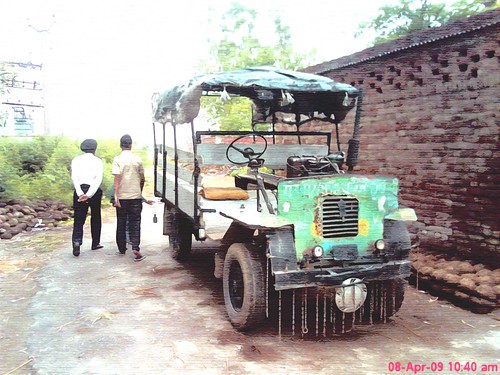
A tale of two Vehicles: the Jaguar and the Jugaad
This recent NYTimes op-ed highlights the ingenious Jugaad, a familiar sight in rural India:
(Click to enlarge)

|
|
... Then there is the jugaad (pronounced jew-gaar), which is nothing like a Jaguar.
It is, for one thing, illegal: a truck tossed together, saladlike, in the sheds of northern India, beyond regulators’ view. Parts from old jeeps are cut and welded and combined with wooden planks to form a chassis. An engine commonly used for irrigation pumps is attached.
Actual bells and whistles may be added as adornments, and the wheels are painted by hand.
The truck gives India’s village dwellers a cheap ride: 10 cents for a half-hour journey with a few dozen others. So compelling is their business logic that jugaads have become popular in dowries.
The truck may be obscure, but the culture behind it is now a management fad. Jugaad, not as noun but as verb, is suddenly the talk of consulting firms like McKinsey and companies like Best Buy in the United States.
The slang Hindi verb “jugaad,” as translated for managers, means to make something much like a jugaad. It is to be innovative despite scarcity — a winning formula for hard economic times. Management gurus cite India’s ultra-low-cost creations as inspiration: the $800 electrocardiogram, the $24 water filter, the $2,500 car, the $100 electricity inverter, the $12 solar lamp.
But these represent only a sliver of what jugaad is. It is more than frugal innovation; jugaad is a way of life, here as elsewhere, that has anticipated important movements of the 21st century, from open-source technology to cultural fusion. From years of observation in India, some core tenets emerge, many of use beyond the business world.
FATALISTIC CREATIVITY: India is not an easy place, and to be fatalistically creative is to transcend its hardships. It is to chafe daily against the way things run; to resist the idealistic temptation to change all that; and to strive instead for success and solutions within the constraints.
... MARKET HUMANISM: Jugaad, as a truck and a way of life, involves a capitalism different from the market philosophy that informs the West — and one that prefigured the interesting new directions that capitalism is taking today.
... ANYONE SOURCING: The black-and-yellow Mumbai taxi, an exemplar of jugaad, was crowd-sourced before Wikipedia and open source before Firefox.
... BOTH-AND TRUTHS: A.K. Ramanujan, the late Indian folklorist, once asked whether there was a specially Indian way of thinking. His conclusion was that Westerners were more comfortable with truths applied universally to every case, while Indians resisted the universal, preferring situation-specific solutions. This is philosophical jugaad: an approach to human dilemmas that rejects the either-or.
Thursday, July 15, 2010
mKRISHI: A multi-lingual platform for farmers
This innovative mobile platform lets farmers send data and images to experts and policy makers. In addition to benefiting individual farmers, the crowdsourced and technology-driven data collection has the potential to catch and quickly resolve problems that plague India's large agriculture sector:

mKRISHI is developed by Tata Consultancy Services Ltd (TCS) as an innovative platform to offer personalized and integrated services to farmers. TCS mKRISHI platform combines multiple technologies to bring vital information regarding local weather, fertilizer requirements based on soil conditions, pest control, and current food grain prices in local markets in a rich content format to the farmer’s low-end mobile handsets. It allows farmers to send queries in their local languages, as well as images and voice activated SMS through a mobile phone and provides personal responses with advice or relevant information in these languages.
... Some of the key benefits to farmers are:
* Advice on pesticides/fertilizers, such as how much and when to spray
* Advice on when to harvest in relation to weather to limit crop damage
* Combining yields allows efficient collection of goods
* Market prices made available so they can choose where and when to sell
* Current pricing information for NCDEX, future prices and global rates
* Bankers can use the mKRISHI programme – enabling more rapid loan payments to farmers
* Useful information such as rural Yellow pages, as well as bus times and railway reservations could improve farmers’ activities.

Wednesday, July 14, 2010
Solar powered ATM's
A series of energy efficient ATM's that rely on biometric authentication, Vortex Gramateller ATM's are currently deployed in just under 100 locations in rural India. The ATM's can accept and dispense soiled (or "teller-grade") notes, a must-have feature in rural India:


Wednesday, June 30, 2010
The Talking Machine from Literacy Bridge
At this year's Foo camp, I attended a session led by Literacy Bridge founder Cliff Schmidt. Cliff demoed the Talking Book, a device they developed after extensive research in Africa:

Aid workers and NGO's working in the developing world have information spanning many topics (best practices and tips in areas like health, agriculture, education, etc.), that could dramatically improve the lives of residents in many remote areas. Areas where cell phone and other communications technologies are unavailable and/or are unaffordable, tend to coincide with lower literacy rates. Valuable information thus gets forgotten and never used.
The Talking Machine is a recording device with an intuitive user interface and navigation model. It's like going though directory assistance, with fewer buttons. The idea is that the devices come with pre-recorded relevant tips and information for local residents. The recording capability means the content can be easily updated. To pass useful content between Talking Machines, two devices can be easily hooked up together.
Craig mentioned a few success stories as well as challenges. He highlighted a small sample statistical study they conducted where a group of farmers in Africa who used the device ended up increasing their yield by over 40%!

Aid workers and NGO's working in the developing world have information spanning many topics (best practices and tips in areas like health, agriculture, education, etc.), that could dramatically improve the lives of residents in many remote areas. Areas where cell phone and other communications technologies are unavailable and/or are unaffordable, tend to coincide with lower literacy rates. Valuable information thus gets forgotten and never used.
The Talking Machine is a recording device with an intuitive user interface and navigation model. It's like going though directory assistance, with fewer buttons. The idea is that the devices come with pre-recorded relevant tips and information for local residents. The recording capability means the content can be easily updated. To pass useful content between Talking Machines, two devices can be easily hooked up together.
Craig mentioned a few success stories as well as challenges. He highlighted a small sample statistical study they conducted where a group of farmers in Africa who used the device ended up increasing their yield by over 40%!
Thursday, June 17, 2010
Mobile Banks are cheaper than traditional Banks
A recent study by CGAP provided a price analysis of simple financial services (targeted at the unbanked) in 10 countries. In particular they studied several use cases including sending/receiving money transfers, short-term safekeeping, medium-term savings and bill payments. The primary goal of the study was to compare costs of conducting transactions through mobile banks and traditional banks. The researchers used data from 16 mobile banks (in 10 countries) and 10 traditional banks (in 5 countries). If you don't have time to read through the 60-slides, I summarize some of the key findings below.
Adjusted for PPP, the average cost for the use cases studied was $3.9 per month (the average is computed across the 16 mobile banking services).

Mobile (or "Branchless") banks are 19% cheaper on average: prices are in US$ and are based on one-month usage of a given service.

(Click to enlarge)
The vast majority of unbanked users conduct low and medium size transactions, for which mobile banks are cheaper options. As transaction amounts increase, traditional banks become more competitive. In fact, for transactions that exceed $200, traditional banks were 45% cheaper.


The graph below details the cost differential for money transfers. The lower the transfer amount, the larger the gap between mobile and traditional banks. At a certain transaction size, money transfers cost about the same whether one uses mobile or traditional banks. For larger amounts, traditional banks are cheaper to use:

(Click to enlarge)
The researchers found that mobile banks were 54% cheaper than the "informal" money transfer services found in many developing countries. The cost of money transfer averaged about 3.1% of the funds transferred for mobile banks, and 6.7% for the "informal" providers.
The researchers also compared costs for what they defined to be "high-usage" accounts. These are accounts that included the following transactions on a monthly basis: at least 2 deposits, 2 money transfers, 2 withdrawals, 2 bill payments, 2 balance inquiries, and 2 airtime top-ups. The "high-usage" accounts would be mobile bank users who "transact like typical bank customers" and as such are reasonable as proxies for financial inclusion. The researchers found that compared to a mere 11% for mobile banks, 89% of bank fees are fixed monthly fees! Since most low-income and/or unbanked customers prefer the pay-as-you-go model, most of them gravitate towards mobile banks.

(Click to enlarge)
One could argue that traditional banks have different costs structures that prevent them from competing with mobile banks in acquiring large numbers of low-income customers. The danger is that they may lose such customers "forever". In a recent survey article, I noted that as mobile banks offer more sophisticated products, they stand a good chance of retaining customers who normally would migrate to traditional banks.
In closing, anyone interested in mobile banks should peruse this study. There are several slides that compare the transaction costs AND usage patterns for the 16 mobile banks covered in the study.
Adjusted for PPP, the average cost for the use cases studied was $3.9 per month (the average is computed across the 16 mobile banking services).

Mobile (or "Branchless") banks are 19% cheaper on average: prices are in US$ and are based on one-month usage of a given service.

The vast majority of unbanked users conduct low and medium size transactions, for which mobile banks are cheaper options. As transaction amounts increase, traditional banks become more competitive. In fact, for transactions that exceed $200, traditional banks were 45% cheaper.


The graph below details the cost differential for money transfers. The lower the transfer amount, the larger the gap between mobile and traditional banks. At a certain transaction size, money transfers cost about the same whether one uses mobile or traditional banks. For larger amounts, traditional banks are cheaper to use:

The researchers found that mobile banks were 54% cheaper than the "informal" money transfer services found in many developing countries. The cost of money transfer averaged about 3.1% of the funds transferred for mobile banks, and 6.7% for the "informal" providers.
The researchers also compared costs for what they defined to be "high-usage" accounts. These are accounts that included the following transactions on a monthly basis: at least 2 deposits, 2 money transfers, 2 withdrawals, 2 bill payments, 2 balance inquiries, and 2 airtime top-ups. The "high-usage" accounts would be mobile bank users who "transact like typical bank customers" and as such are reasonable as proxies for financial inclusion. The researchers found that compared to a mere 11% for mobile banks, 89% of bank fees are fixed monthly fees! Since most low-income and/or unbanked customers prefer the pay-as-you-go model, most of them gravitate towards mobile banks.

One could argue that traditional banks have different costs structures that prevent them from competing with mobile banks in acquiring large numbers of low-income customers. The danger is that they may lose such customers "forever". In a recent survey article, I noted that as mobile banks offer more sophisticated products, they stand a good chance of retaining customers who normally would migrate to traditional banks.
In closing, anyone interested in mobile banks should peruse this study. There are several slides that compare the transaction costs AND usage patterns for the 16 mobile banks covered in the study.


 Posts
Posts


