

|
|
... Then there is the jugaad (pronounced jew-gaar), which is nothing like a Jaguar.
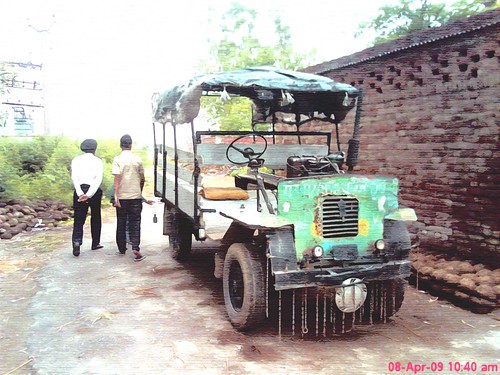
It is, for one thing, illegal: a truck tossed together, saladlike, in the sheds of northern India, beyond regulators’ view. Parts from old jeeps are cut and welded and combined with wooden planks to form a chassis. An engine commonly used for irrigation pumps is attached.
Actual bells and whistles may be added as adornments, and the wheels are painted by hand.
The truck gives India’s village dwellers a cheap ride: 10 cents for a half-hour journey with a few dozen others. So compelling is their business logic that jugaads have become popular in dowries.
The truck may be obscure, but the culture behind it is now a management fad. Jugaad, not as noun but as verb, is suddenly the talk of consulting firms like McKinsey and companies like Best Buy in the United States.
The slang Hindi verb “jugaad,” as translated for managers, means to make something much like a jugaad. It is to be innovative despite scarcity — a winning formula for hard economic times. Management gurus cite India’s ultra-low-cost creations as inspiration: the $800 electrocardiogram, the $24 water filter, the $2,500 car, the $100 electricity inverter, the $12 solar lamp.
But these represent only a sliver of what jugaad is. It is more than frugal innovation; jugaad is a way of life, here as elsewhere, that has anticipated important movements of the 21st century, from open-source technology to cultural fusion. From years of observation in India, some core tenets emerge, many of use beyond the business world.
FATALISTIC CREATIVITY: India is not an easy place, and to be fatalistically creative is to transcend its hardships. It is to chafe daily against the way things run; to resist the idealistic temptation to change all that; and to strive instead for success and solutions within the constraints.
... MARKET HUMANISM: Jugaad, as a truck and a way of life, involves a capitalism different from the market philosophy that informs the West — and one that prefigured the interesting new directions that capitalism is taking today.
... ANYONE SOURCING: The black-and-yellow Mumbai taxi, an exemplar of jugaad, was crowd-sourced before Wikipedia and open source before Firefox.
... BOTH-AND TRUTHS: A.K. Ramanujan, the late Indian folklorist, once asked whether there was a specially Indian way of thinking. His conclusion was that Westerners were more comfortable with truths applied universally to every case, while Indians resisted the universal, preferring situation-specific solutions. This is philosophical jugaad: an approach to human dilemmas that rejects the either-or.


 Posts
Posts

